Category Archives: Call For Papers

CALL FOR PAPERS: BHARAT RATNA DR. B.R. AMBEDKAR LEGAL RESEARCH CENTRE  

ABOUT SIDDHARTH COLLEGE OF LAW, MUMBAI 

Siddharth College of Law,Mumbai was founded in Mumbai in 1956. It is run by the People’s Education Society which was formed by Dr. Babasaheb Ambedkar on 8 July 1945. The college is affiliated to the University of Mumbai. The college was formed with a vision to spread legal education amongst all sections of society.  

ABOUT ALRC 

Bharat Ratna Dr B.R. Ambedkar Legal Research Centre (An Initiative of Siddharth College of Law, Mumbai) was inaugurated in 2010 by Hon’ble Chief Justice of India Dr. D.Y. Chandrachud and Hon’ble Justice Abhay Oka. Eminent legal personalities such as the Late Hon’ble Justice Krishna Iyer andthe Late Prof Madhav Menon were associated with the centre as Honorary Members.  

REVITALIZATION OF THE CENTRE 

ALRC is currently being revitalized by Adv. Eshan Borikar and Adv. V. Mangala under the overall guidance and supervision of Principal Ms. Sandhya Dokhe and Dr. Arunachalam Chettiar. ALRC is initiating various research projects. Furthermore, it is launching its own legal blog and the Ambedkar Law Journal. 

AMBEDKAR LAW JOURNAL 

The Ambedkar Law Journal is a double-blind peer-reviewed journal on all aspects of law, centered at Siddharth College of Law, Mumbai. 

CATEGORIES OF SUBMISSIONS 

  1. Research Papers/Articles(5000-7500 words, including foot notes)  
  1. Essays (3000-5000 words, including foot notes) 
  1. Case/Legislative Analysis, Book/Article Reviews (1500-2500 words, including foot notes)  

ELIGIBLE TO SUBMIT 

5 Year LL.B Students, 3 Year LL.B Students, LL.M Students, PHD Research Scholars Academicians ,Advocates, Legal Professionals, Bureaucrats and  Experts Possessing Special Knowledge in the field of Law. 

THEMES 

It welcomes traditional, contemporary legal articles as well as interdisciplinary work on various themes, as set out below: 

  1. Centre for Constitution 
  1. How Indian Constitution is different from other countries Constitution? 
  1. Assessment of Important Amendments to the Indian Constitution
  1. Preamble: Mirror of Indian Constitution
  1. Developments in Schedules of Indian Constitution
  1. Union, State & Concurrent Lists of Indian Constitution
  1. Role of Federalism in Indian Constitution. 
  1. India’s Collegium System: Boon or Bane. 
  1. Transformative constitutionalism. 
  1. Constitutional Moralism. 
  1. Centre for Criminal Law and Justice 
  1. Genesis of Criminal law in India. 
  1. Criminal Justice system in India. 
  1. Critical assessment of criminal justice system in India. 
  1. Responsibilities of stakeholders in Criminal Justice system in India. 
  1. Role of Legal Educational Institutions in diminishing Crimes. 
  1. Critically analyze the need to revolutionize criminal laws in India. 
  1. Consolidation of Criminal Laws is a new way ahead. 
  1. Decriminalization of certain offences is a need of an hour. 
  1. Comparative analysis of Criminal laws in India and Arab Nations. 
  1. Centre for CorporateLaws 
  1. Recent legal developments in Banking & Finance. 
  1. Insolvency and Bankruptcy. 
  1. Mergers and Acquisitions. 
  1. Securities Law. 
  1. Legal issues in E-Commerce Laws. 
  1. Foreign Exchange Laws. 
  1. Real Estate Laws. 
  1. Labour and Employment Laws. 
  1. Role of SEBI in the wake of ongoing Stock Market Crisis. 
  1. A need to reform Insolvency and Bankruptcy Code, 2016. 
  1. Analyze the Impact of Related Party Transactions on Indian Corporates. 
  1. Centre for Intellectual Property Law 
  1. Copyright and Related Rights. 
  1. Right of traders in their trademarks. 
  1. Right of manufacturers & producers on geographical indication in relation to such products and produce. 
  1. Right of designers for their distinctive design striking to the eye. 
  1. Patents or Geographic Indication. 
  1. Centre for Human Rights and International Law 
  1. Facets of International Human Rights 
  1. Human rights in Indian Perspective 
  1. Discuss an Ongoing Human rights Crisis across the world. 
  1. Socio-economic impact of the Afghan Crisis. 
  1. Analyze the current position of the Marginalized Community in India. 
  1. The major landmarks in the evolution of the international human rights regime 
  1. Evolution and Distinctions in Various Human Rights Treaties 
  1. Importance coordination of Human Rights in different jurisdictions, etc. 
  1. An act to protect LGBTQIA from sexual harassment? 
  1. Human rights and black laws in India. 
  1. Centre for Environment and Sustainable Development 
  1. Impact of Climate change. 
  1. Various legal international agreements and treaties on climate change and environmental protections. 
  1. Remedial actions to arrest climate degradations. 
  1. Carbon credit. 
  1. Climate refugees and sharing of resources. 
  1. Critical analysis Environment impact assessment. 
  1. ECOMARK – Lack of incentive and awareness- The way forward for success of the project. 
  1. Town Planning is an essential mode for Sustainable Development. 
  1. Centre for Domestic and International Taxation 
  1. Nature, relevance and impact of domestics and international taxation from a legal perspective. 
  1. Transfer Pricing. 
  1. Relevance of Bilateral Treaties for Tax Concession. 
  1. Centre for Gender Equality and Child Development 
  1. Domestic violence and its impact on Women. 
  1. Shadow Pandemic: – Covid and Post Covid Actions. 
  1. Expanding interpretation of existing laws by making it more third gender inclusive. 
  1. Domestic workers and the inequality that surrounds them. 
  1. Denial of access to education to children of prostitutes- growing concerns over their Fundamental Rights. 
  1. The growth of a child happens in a classroom and not in an hazardous industry- growing menace of child labour in India in the present times. 
  1. Child marriage- an archaic practice but an existing reality- measures to curb this evil. 
  1. Marital Rape 
  1. Domestic Violence 
  1. Use of child in terrorism and drug mafia- misuse of child protective laws. 
  1. Centre for Jurisprudence 
  1. Jurisprudence, Interpretation and General Laws 
  1. Legal and Regulatory Framework for jurisprudence, etc. 
  1. Study the evolution of Constitutional Jurisprudence in India. 
  1. How special laws erode the general law jurisprudence? 
  1. Undertake the comparative analysis of Criminal Jurisprudence across the world. 
  1. Centre for Law and Technology 
  1. Legal principles of technology. 
  1. Cyber crimes and Cyber security. 
  1. Critically Analyze the role of Artificial Intelligence in the                Legal Field. 
  1. Analyze the need for the development of an advanced legal system to tackle the crimes committed through Modern Day Technology. 
  1. Artificial Intelligence and it’s Legal Liability. 
  1. Analyze the impact of Metaverse in the Legal Field. 

IMPORTANT NOTE: –The Above list is not exhaustive in nature. The Author(s) can also choose other topics relevant to law. 

FORMAT 

The Body of the manuscript shall be of the following format: 

  1. Font: Times New Roman 
  1. Heading Font Size-14 
  1. Body Font Size: 12 
  1. Line Spacing: 1.5 
  1. Alignment: Justified 

The Footnotes of the manuscript shall be of the following format: 

  1. Font: Times New Roman 
  1. Font Size: 10 
  1. Line Spacing: Single 

CITATION FORMAT 

Citation Format: The author(s) shall provide due credit to the original work through citation. Author(s) shall insert citations as footnotes conforming to the referencing style of The Bluebook: A Uniform System of Citation (20th or 21st ed.) 

Citations of electronic sources should include an author or editor, the title of the text, date, the title of the website, the electronic address, and page or paragraph numbers. 

GUIDELINES FOR THE SUBMISSION 

  1. The author(s) shall submit an abstract of not less than 200 words and not more than 300 words, along with 5 keywords. The abstract shall be concise and precise to the manuscript submitted by the author(s). 
  1. Co-authorship is permitted up to 2 authors. 
  1. Submissions shall be in English language only. The journal does not accept submissions in languages other than English. 
  1. All submissions must be original, unpublished, and not under consideration to be published by any other journal/forum. Any form of plagiarism will lead to the rejection of the manuscript. The maximum permissible plagiarism is 15%. 
  1. All submissions are to be made in the MS Word format document. 
  1. The author(s) shall submit a cover letter containing details of the author(s)’s Full name, Designation, semester & course (if a student), university/organization/freelancer (specify), contact number, and E-Mail ID. 
  1. All Submissions should include 4 to 5 key takeaways of their Manuscript. 
  1. All Submissions for the journal must be sent to Submission@drambedkarlegalresearchcentre.com

PUBLICATION GUIDELINES 

  1. The authors cannot withdraw the manuscript after submission and during the review process. 
  1. The Editorial Board will review the submissions, and the decision of the editorial board will be final. 
  1. The Editorial Board can recommend suggestions or make necessary changes as per requirement. 
  1. All the selected Manuscripts will be published in Ambedkar Law journal. 
  1. All rights regarding the manuscripts will be reserved with Bharat Ratna Dr. BR. Ambedkar Legal Research Centre. 

PERKS 

The centre is pleased to announce that the top 5 articles will also be awarded with the opportunity to get associated with the research centre on various upcoming research projects. This will enable the authors to garner hands-on experience in the area of research. We encourage all authors to submit their best work and reap the benefits of this opportunity.  

The centre is also pleased to announce that the top 20 entries will be awarded with e-certificates recognizing their effort in contributing to the field of research. These certificates will also aid as a milestone in enhancing the professional portfolios of the participants. Please Note: – All the selected Manuscripts will be published in our Law journal. 

TIMELINE OF SUBMISSION 

  1. Date of Submission of Abstract for /Articles/ Case Analysis/ Legislative Analysis/ Book Review and Article Review: – 15th May,2023. 
  1. Communication of Selected Abstracts for /Articles/ Case Analysis/ Legislative Analysis/ Book Review and Article Review: – 31st May,2023. 
  1. Submission of Final Research Paper /Articles/ Case Analysis/ Legislative Analysis/ Book Review and Article Review: – 21st June ,2023. 
  1. Communication of Selected Research Papers/Articles/ Case Analysis/ Legislative Analysis/ Book Review and Article Review – 10th August,2023. 

CONTACT INFORMATION IN CASE OF ANY QUERIES 

Contactus@drambedkarlegalresearchcentre.com 

CFP : Journal For Law Students And Researchers [Volume III, Issue II] : Submit By March 1st, 2022

ABOUT THE JOURNAL

Journal for Law Students and Researchers [JLSR]  is an Online Journal with ISSN[O]: 2582-306X and 15+ indexings, which is quarterly, Peer-Reviewed, published online and JLSR seeks to provide an interactive platform for the publication of Short Articles, Long Articles, Book Reviews, Case Comments, Research Papers, Essays in the field of Law.

JLSR welcomes contributions from all legal branches, as long as the work is original, unpublished, unplagiarized and is in consonance with the submission guidelines.

NATURE OF CONTRIBUTIONS

  • Articles: An article must conduct a complete analysis of the area of law, which the author seeks to highlight. It must contain a comprehensive study of the existing law with the suggestions and conclusions of the Author. Word Limit being 1,100 to 4,000 words.
  • Notes: A note is a relatively concise form of an argument advanced by the author. The focus of a note should be on a relatively new debate or controversy regarding the interpretation or implementation in the law. Notes shall primarily highlight contemporary issues, which need to be addressed, and the authors are expected to offer a solution. The maximum word limit for a manuscript in the form of note is 1,500-2,500 words.
  • Comments: A comment is where the author may decide to critique any recent/landmark judicial pronouncement or any recent legislation or bill before the Parliament or State Legislature. The word limit for a comment is 2,000-3,000 words.
  • Book Review: A Book Review is where the author identifies the central idea of the book, gives the reader indication of the author’s style, approach, or premises, and then offers an overall evaluation adding suggestions and latest amendments to the given laws in the book. The word limit is from 2,000-3,000 words.

DATES

  • Last date for full paper submission: 1st March, 2022 (Submissions should be made in Word Doc.)
  • Intimation of the selection of Full Paper: Within 24 hrs of submission.

SUBMISSION GUIDELINES

  1. Citation Format: The citation format to be followed is The Bluebook (19th Ed.)/Any Standard Format.
  2. Abstract: Every submission should be accompanied by an abstract of 250-300 words describing the relevant conclusions drawn in the manuscript.
  3. Papers with plagiarism less than 25% are only eligible for publication.
  4. Font Style: Times New Roman and font size 12.

PUBLICATION FEE

Single Authored: 800/-

Co-Authored: 1000/-

Note : Payment to be made only after selection and not before.

MODE OF SUBMISSION

Submission of the full article/paper along shall be made by sending an e-mail at editor.jlsr@gmail.com.

CONTACT INFORMATION

9136804644

E-mail: jflsrjournal[at]gmail.com

The website link is here.

For more such opportunities; Join Team Attorneylex’s WhatsApp group to get notified immediately. Also check us out on Instagram and Twitter

Call For Papers: Lex-manthan [Volume-13] Book With Isbn : Submit By March 1st, 2022

Aim   

The Book aims to provide a detailed insight into a full range of various legal topics.

Theme

The book would not be theme-specific. Anything related to Law is acceptable.

How to Submit?

Mail the manuscript at lexmanthan@gmail.com with subject line “Submission”.

Important Dates and Deadlines

  • Submission of full paper(s): March 1, 2022
  • Intimation of acceptance/rejection: Within 24 hours of submission
  • Tentative month of Release of the Book: March/April, 2022.

Submission Guidelines

  1. The title of the research paper should be appropriate.
  2. The paper shall be original and unpublished.
  3. The paper should not be plagiarized, and free from grammatical, spelling, and other errors.
  4. Co-authorship is allowed subject to a maximum of two (authors can be from different institutes).
  5. Full names of all the authors along with designation and contact number(s) must be given.
  6. Any uniform method for citation may be followed.
  7. The body of the paper shall be in Times New Roman, font size 12, 1.5 line spacing. Footnotes should be in Times New Roman, size 10 single line spacing
  8. A margin of 4 centimeters shall be left on all sides of the paper.
  9. Page borders, headers, footers shall not be used.
  10. The paper shall be in MS Word Format

Word Limit (Subject to Relaxation)

  • Notes/Comments: (between 3000-5000 words including footnotes)
  • Cases/Report Commentaries: (between 2500-3000 words including footnotes)
  • Articles: (between 1200-5000 words including footnotes)
  • Short Notes: (between 1000-2500 words including footnotes)
  • Book/Report Review: (between 2000-3000 words including footnotes)

Format

The format of the book is Print. Contributors are provided with a digital copy of the book on their e-mail id along with a certificate of publication. To procure a printed copy of the book, extra charges would apply.

Publication Charges

  • Single authored chapter: INR 400/-  
  • Single authored chapter with hardcopy book: INR 660/- 
  • Co-Authored Chapter: INR 600/-
  • Co-Authored chapter with hardcopy book: INR 850/- 

Note: Payment to be made only after selection.

Contact Details

For more such opportunities; Join Team Attorneylex’s WhatsApp group to get notified immediately. Also check us out on Instagram and Twitter

Call For Papers: The GNLU Law Review [Volume Ix Issue I] – Submit By 15th March 2022

THE GNLU LAW REVIEW

About 

Gujarat National Law University, Gandhinagar, is one of the premier National Law Schools in India, which has contributed towards transforming legal education into professional excellence ever since its establishment in 2003.

Born in 2008 as the flagship journal of Gujarat National Law University, The GNLU Law Review (‘TGLR’) is a bi-annual, student-edited, peer-reviewed journal, designed as a vehicle for promoting multifarious contemporary legal research. It was envisioned to address the need for broadening the platform for academicians, professionals, researchers, and students, where knowledge and scholarship of new and innovative ideas in legal and associated disciplines could be exchanged and disseminated.

Internationally recognized with ISSN number 0974-9810, the journal aspires to create awareness on developing areas of law in India and around the world. In the past, the law review has seen contributions from eminent legal scholars from around the globe. 

Guidelines

TGLR is open for academicians, practitioners, research scholars, and postgraduate students. All submissions must be accompanied with an abstract of not more than 250 words. Up to 5 keywords should also be provided. 

TGLR does not follow any particular theme. However, preference would be given to the submissions made pertaining to contemporary legal issues. 

The contributions submitted towards publication in TGLR must not have been previously published or currently submitted for publication elsewhere. The contributions shall be evaluated on the basis of originality, innovativeness, clarity and technical correctness. Authors shall solely be responsible for the accuracy of statements in the article.

Co-authorship is allowed to a maximum of 2 authors. The manuscript must not contain the name of the author(s) or his/her institutional affiliation or any other information. A separate cover letter containing the name of the author(s), professional information, contact details and other relevant information must be provided.

Categories

  • Articles (5000-8000 words, excluding footnotes).
  • Essays (3000-5000 words, excluding footnotes).
  • Book Reviews/Case Commentary/ Legislative Comments (1500-3000 words, excluding footnotes).

Formatting and Citation Style 

  • Submissions must be made in Microsoft Office (doc./docx.) formats only.
  • The paper should be free from all grammatical and spelling   errors.
  • The body of the manuscript must be in the font ‘Times New Roman’, font size 12, line spacing 1.5 and the text should be justified.
  • All footnotes must be in Font ‘Times New Roman’, font size 10, line spacing 1 and justified. All submissions must follow the ‘The Bluebook: A Uniform System of Citation (20th Edition)’. The authors may refer to The GNLU Law Review Citation Guide from here.
  • Non-conformity will be a ground for rejection.

Submission Procedure

The deadline for making submissions is 15th March 2022. All submissions shall only be made to tglr@gnlu.ac.in with the subject ‘Manuscript Submission for Volume IX Issue I’.

Copyrights

The contributions presented to and accepted for publication and the copyrights therein shall be the intellectual property of TGLR. However, in exceptional circumstances, the contributions could be published elsewhere with the prior written permission of the Editor-in-Chief.

Indemnification

All contributors, by submitting any contribution towards TGLR, agree to indemnify the Gujarat National Law University and TGLR from and against all claims, suits, and damages based on any claim of copyright infringement, plagiarism or unauthorized use.

Contact

For any queries, write to us at tglr@gnlu.ac.in with the subject ‘Query regarding Volume IX Issue I’.  

For more information on TGLR, click here.

For more such opportunities; Join Team Attorneylex’s WhatsApp group to get notified immediately. Also check us out on Instagram and Twitter

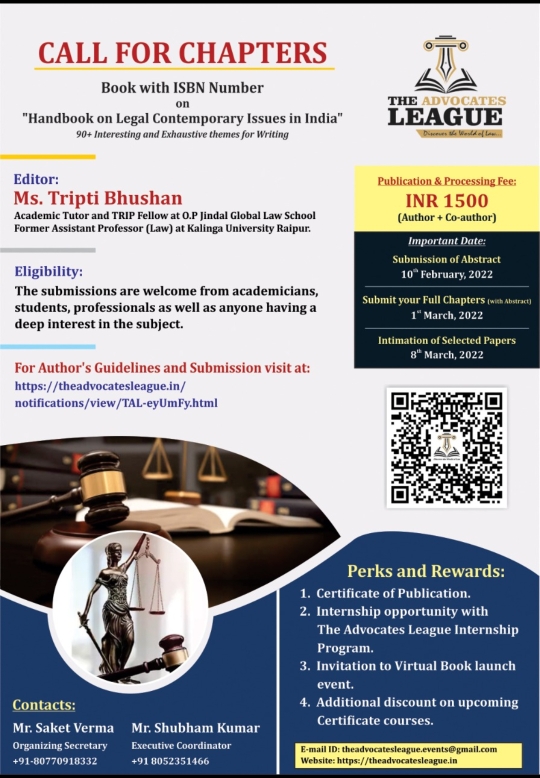
Call for Chapters book with ISBN: Submit the Abstract by 10th Feb, 2022

About the Organizations

The Advocates League [TAL] is an ISSN approved Journal & a legal research initiative whose work is mainly dedicated to legal research and publication. It also host several events which include Certificate courses, Competitions, Workshops and Webinars. The Advocates League has a team of students and alumni of various law colleges and universities of the country. It is blessed to have well-reputed Professors and practicing advocates as members of its ‘Editorial Board’. With a dedicated team and mission to bring meaningful reform in legal education, the team commit itself to excellence. TAL also aims to provide better legal aid so that it can emancipate individuals from all kinds of hindrance in seeking access to justice.

About the Call for Chapters

Call for Chapters is organized by The Advocates League to provide an opportunity to the Law Students, Academicians, Advocates to publish their hand piece in a book of compiled chapters. The book will be published with an ISBN number in hardcopy & same will be launched in a program organized by the Advocates League. Chapters will have to qualify double touchstone i.e., Abstract Selection & Chapter Selection. Each chapter will be checked & edited by the Editor of this book. This book will comprise of all the relevant topics in current legal scenario which will be going to be useful for law students and also those who are going to start the journey in the legal field to have clear and basic understanding of the issues happening in the country “Handbook on Legal Contemporary Issues in India” will guide throughout the students & help in nurturing the education system. The Book has essays explained on Topics as, Sports law, Indian Judiciary, Anti‐ Defection laws, Rape laws, Travel laws, Analysis of Police Brutality in Law Enforcement, Role of Media, Indecent Representative Act, Data Privacy and Security issues, Drug Trafficking and Drug Abuse, Money Laundering and Illegal Wildlife trade, Constitutional right to education, An Analysis of Model Tenancy Act 2021 etc.

About the Editor: 

Ms. Tripti Bhushan (Academic Tutor and TRIP Fellow at O.P Jindal Global Law School, Former Assistant Professor (Law) at Kalinga University Raipur.

Eligibility:

  • The submissions are welcome from academicians, students, professionals as well as anyone having a deep interest in the subject.

Theme/Topics: 90+ interesting and exhaustive topics (refer to brochure).

For Submission of Abstract and Chapter visit: Click here or

https://theadvocatesleague.in/notifications/view/TAL-eyUmFy.html

NOTE: Hurry Up!! The book will be compiled of limited numbers of Chapters, so submit your Abstract as soon as possible.

Publication & Processing Fee:

  • INR 1500 (Author + Co‐author) Pay only after selection of Chapter.

Important Dates:

  • Submission of Abstract (Through Google Form): 10 February, 2022
  • Intimation of Selected Abstract: Within 48 hours of Submission
  • Submit your Full Chapters (with Abstract): 1 March, 2022
  • Intimation of Selected Papers: 8 March, 2022

Perks & Rewards:

  • A Great accomplishment in your CV. 
  • Certificate of Publication to all authors.
  • The Book will be Forwarded by renowned Legal fraternity. 
  • Hard Copy of Book will be delivered to your address (Chargeable). 
  • Invitation to Virtual Book launch event. 
  • Internship opportunity with The Advocates League Internship Program. 
  • Additional discount in upcoming Certificate courses.

For More Details Contact:

  • Mr. Shubham Kumar, (Executive Coordinator) 

Contact: 8052351466

  • Mr. Saket Verma, (Organizing Secretary)

Contact: 80770 91833

For other queries: theadvocatesleague.events@gmail.com 

Website: https://theadvocatesleague.in/ 

For more such opportunities; Join Team Attorneylex’s WhatsApp group to get notified immediately. Also check us out on Instagram and Twitter

Call for Chapters | Emerging Transformational Law | Submit your Abstract by 1st March 2022

About the Book

In today’s world, changes are being brought into the Legal System as Lakhs of cases are filed in the courts opposing a current law. The future generation requires changes or modifications to be brought into the legal system .With the evolving world, there is a considerable need to introduce further discussions and perspectives concerning the legal issues happening around us.

Alternate dispute resolution, cryptocurrency, data protection, technology regulation, labour code are just a few Legal transformations that made the headline recently. This edited book shall create a safe place for open discussion on all the transformations in the legal world. 

Theme – The topic shall be under the scope of any contemporary issue in Law. 

Guidelines of Submission

  • The work submitted shall be ORIGINAL and UNPUBLISHED.
  • Acceptable Plagiarism limit is 15%.
  • When reviewing submissions, the Editorial Board considers whether the manuscripts are contemporarily relevant, topical and creative.
  • Citation: The Citation style should be in consonance with 20th Edition Bluebook Style
  • The copyright of the entry to the Book will rest with the Editorial Board once the entry has been selected and the authors(s) of the same have been notified.
  • The final decision as to the acceptance of manuscripts rests with the Editorial Board. 

The body of the paper shall be:

  • Font: Times New Roman Font Size: 12 Line Spacing: 1.5 
  • Citations Shall be: Font: Times New Roman Font Size: 10 Line Spacing: 1

Word Limit (Exclusive of Footnotes)

  • Research Papers: It must comprehensively analyse a specific issue including the status quo, indicating the lacunae and potential solutions. Author(s) may compare the law or judicial approach of other jurisdictions to strengthen the argument in between 3,000 to 4,500 words.
  • Short Articles: They are more concise than articles, in terms of scope and conceptualization. It should be between 2,000 and 3,000 words.
  • Case Comments: Prescribed word limit is between 2,000 to 3,500 words.

Submission

  • All the Articles, Short Articles and Case Comments being contributed for the Edited book are to be sent at: submission.etl01@gmail.com
  • The manuscript must be accompanied with an abstract of paper in not more than 300 words.
  • The manuscript (including the abstract) must not contain any indication of the identity of the author.
  • The abstract entries should reach the given email ID before 5:00 PM IST, 1st March 2022.
  • After selection of abstract, author(s) will be communicated within 7 days.
  • Author(s) will then have to pay the prescribed fee.
  • The author(s) need to submit their full paper by 31st March 2022.
  • Entry should be in either ‘.doc’ or ‘.docx’ format.
  • A cover letter in either ‘.doc’ or ‘.docx’ format, mentioning the name, contact numbers, name of the institution, name of the university should be attached SEPARATELY along with the article itself in the same mail.
  • The subject of the mail should be: “Submission for Edited Book”.

Processing Charges (To be paid after acceptance)

– For Indian Authors there will be a processing charge of: 

  • Single Author – 300 INR
  • Co-Authored Article – 500 INR

– For International Author there will be a processing charge of: 

  • Single Author – $5
  • Co-Authored Article – $7.

Further,

  • The charges shall be applicable only to the selected manuscripts for publication.
  • An E-certificate of publication will be provided after the publication of the Book.
  • The Estimated Month of the publication shall be April 2022.

Register here: https://forms.gle/ruvMogdk9nrwp2Rd8

Detailed brochure: https://drive.google.com/file/d/1giBb1e6k23yCCvSnvB3vR0RoKXzTdFZh/view?usp=drivesdk

Contact

For more details, 

Contact: submission.etl01@gmail.com

For more opportunities; Join Team Attorneylex’s WhatsApp group to get notified immediately. Also check us out on Instagram and Twitter

CALL FOR CHAPTERS | A Compilation of Legal Research (Edition 3) 

Law Essentials invites Chapters in the form of Articles, Short Notes, Book Reviews Case/Report Commentaries and other such for its book to be published with ISBN number.

The writer may talk about the various contemporary legal issues which are relevant in the current legal discourse. Every lawyer is well aware of the importance of writing articles. This opportunity will enable writers to capitalise on the same! This publication will help writers flaunt their analytical skills and add an ISBN number to their CV.

How to Submit?

All submissions are to be made via email only as MS Word documents at: lawessentials1234@gmail.com with subject ‘Chapter Submission’

Important Dates and Deadlines

  • Submission of full paper(s): 1st March, 2022
  • Selection of submission: Within 24 hours
  • Release of book: 10th March, 2022 

Submission Guidelines

1. Abstract (Minimum 300 Words), with at least 5 keywords, along with final paper should be sent by the last date of submission. 

2. The title of the paper should be followed by Name of the Author, Designation, Name of the Organization/University/Institution and Email address. Name and details of Co-author (if any) to be added.

3. The authors are duly expected to follow the prescribed format:

  –MS Word Document and NOT in any other format.

  –The font shall be in Times New Roman of font size 12, with a spacing of 1.5. 

 –The footnotes to be in Times New Roman of font size 10. Endnotes are not to be used.

  –A margin of 4 cm shall be left on all sides of the paper.

  –Page borders, headers, footers shall not be used.

  –Footnotes should conform to 20th Bluebook Citation.

  –The paper shall be original and unpublished.

4. All articles submitted will be checked for plagiarism. Plagiarized submissions will be rejected for publication. The authors are strictly expected to acknowledge the references made use of.

5. Co-authorship will be allowed to a maximum of two authors.

6.The length of paper should not be below 1,500 words (including footnotes) and should not exceed more than 10,000 words (including footnotes).

Copyright

*The contributions presented to and accepted for publication and the copyrights therein shall be the Intellectual Property of Law Essentials Organization.

All entries will be reviewed by the editors before publication.

Rewards

  • All entries will receive the E-Certificate of publication.
  • All the published manuscripts will be compiled in our printed book as well as in our E-Book.

Publication Charges

  • Single authored chapter: INR 500/-
  • Co-Authored Chapter: INR 600/-

Note: Payment to be made only after selection.

Contact Details

For any queries, write us at lawessentials1234@gmail.com

For more info visit – lawessential.com

Call for Papers: Maharishi Journal for Law & Society, Vol. III Issue II [Submit by 25 March 2022]

Call for Papers at Maharishi Journal for Law & Society, Vol. III Issue II with ISSN: 2581- 8007, RNI: UPENG/2018/7632 by Maharishi Law School, Maharishi University of Information Technology, Noida [Submit by 25 March 2022]

About Maharishi University

Maharishi University of Information Technology (MUIT) was established under MUIT Uttar Pradesh Act No. 31 of 2001 Notification No. 573 dated 06 October, 2001. The University Campus is at PO- Maharishi Nagar Dist. GB Nagar, Sec 110, Noida, Uttar Pradesh. The University is reputed to disseminate quality education. His Holiness Maharishi Mahesh Yogi Ji was the First Chancellor of the University. MUIT has been recognized and included in the list of the Universities, maintained by the UGC under section 2 (f) of the UGC Act, 1956. The University offers B.Sc. in Animation & Multimedia with Life Skills, M.Sc. in Animation and Multimedia with Life Skills, B.Tech in Computer & Data Science, B. Tech in Computer Science & Engineering, M.Sc. in Data Science, P.G. Diploma in Data Science, BBA LL.B, B.A. LL.B, LL.B, LL.M and Ph.D (Law) courses.

About Maharishi Law School

Maharishi Law School (MLS) established in 2017 under Maharishi University of information Technology. Maharishi Law School is one of the premier Law School managed by Maharishi Society. This Law School is known for its teaching methodology and offers its UG and PG programs. The School of Law also encourages the students to participate in academic events like Moot Courts, Debate, Quiz, Seminars, Conferences and workshops etc. in inter university/ college and intra college competitions. The MLS also maintains a free Legal Aid Clinic so as to acquaint the students with the client counsel interactive process. MLS have a spacious law library with good number of text books, law journals, periodicals as well as online access to legal data bases for catering the needs of the students. MLS believes to achieve excellence in education progress serving the public and fostering justice.

MLS objective towards legal fraternity is not only the dissemination of legal knowledge but also includes the agenda of national development by the proper delivery of justice at every end, We at MUIT, strive to offer the best of everything to our students. Keeping up with the title of being one of the best Private Law Schools in Noida, we make sure that the students and faculties don’t face any problems within the campus. Having said this, we take immense care about the safety and security of all our students and staff, both within and outside the campus.

About the Journal

It is a matter of great pleasure to inform you that Maharishi Law School is coming up with its Vol.3 Issue- 1, Annual Double-Blind Peer Reviewed Refereed National Journal – Maharishi Journal of Law & Society. This Journal is aimed at bringing together the thoughtful persons from Industry and Academia engaged in Law profession. It is our endeavor that we would like to set an agenda for Research & Development.

We hereby take this opportunity to invite you to contribute Research Papers/Articles/Book Review on the contemporary issues related to the field of law. The detailed guidelines for contributors are enclosed herewith.

We request you to enrich our Journal by your valuable contributions. We shall be thankful to you if you could circulate this information among your colleagues, research scholars and students interested in research and publications.

Theme

Any Contemporary Issues related to Law.

Important dates

  • Last date for full paper submission: 25 March 2022
  • Intimation of the selection of Full Paper: Within 15- 20 days

Guidelines for Submission

  • Abstract: Every submission should be accompanied by an abstract of 250-300 words describing the relevant conclusions drawn in the manuscript.
  • Copyright: Author(s) shall warrant that the paper submitted for publication do not infringe the copyright of any other person. Except agreed otherwise, the copyright of the articles published shall vest with the publisher, viz., the Maharishi Law School, Noida. However, editorial board of Law Journal of the University shall not be liable for any copyright infringement by the authors.
  • Cover Page: In order to facilitate anonymity, authors must mention their names, contact details and affiliations only on the cover page of the manuscript.
  • English: Follow British spellings and punctuation conventions.
  • Font Size & Style: Kindly use Times New Roman, 12 point, for the main text and 10 point for footnotes.
  • Headings: The heading should be used as per the following style:
  • First Heading: 14 pt, bold, centre
  • Second Heading: 12 pt, bold, left- aligned
  • Third Heading: 12 pt, Italics, Centre
  • Length: Articles should generally be between 8,000 and 10,000 words (including footnotes. Notes, case comments and book reviews should be between 3,000 and 5,000 words. The Editorial Board may, however, accept longer submissions in appropriate cases.)
  • Line Spacing: The line spacing of main text of paper should be 1.5.
  • References: Footnotes should be used and not end notes.
  • Footnoting Style for Book and Articles: Books: Name of the author, Title of the book (in italics), addition (if any), name of the publisher, place of publication, year, page no., Articles: Name of the Author, Title (In Double Quotes), Name of Journal, Volume, Year, Page No. (Otherwise, the mode of citation provided in the journal itself).
  • Review Process: All papers will be reviewed anonymously by the editorial board. Author(s) will be notified within 4-6 weeks about the status of their papers. Request for expedit review may not be entertained.
  • Substance: Paper should contain an original contribution to scholarship by making a cohesive argument supported with appropriate authorities.
  • Quotations/ Quotation Mark: Quotations over 50 words should be intended. Double quotation mark should be used; single quotation mark should be used only for quotes within a quotation.
  • Complimentary Copies: All author(s) will be provided one complimentary copy of the issue in which their paper appears.

Publication Fees: NIL

To Submit, Click Here ( https://docs.google.com/forms/d/e/1FAIpQLSf-4M9nlphvDrwMclvF35gkvKgO0X1Zo6kk-4dBfdmpMoYfOw/viewform )

For More Details, Contact

For more such opportunities; Join Team Attorneylex’s WhatsApp group to get notified immediately. Also check us out on Instagram and Twitter

Call For Papers | Journal Of Indian Legal Thought: Submit By Feb 28

About School of Indian Legal Thought

School of Indian Legal Thought, Mahatma Gandhi University, was established in 1989 to impart an integrated legal education with unique programmes for Under-Graduate, Post-Graduate and Research levels. One of the major objectives of the School is to undertake systematic research and study of law with a dynamic curriculum that is constantly evolving and by engaging in innovative interdisciplinary research.

Call for Papers by Journal of Indian Legal Thought

The School of Indian Legal Thought, Mahatma Gandhi University invite you to contribute to the Journal of Indian Legal Thought 14th Volume 2020 and 15th Volume 2021 (ISSN 2249-9989).

Having been published from 2003 onwards the double-blind peer-reviewed Journal of Indian Legal Thought includes original research articles, case comments, short comments and book reviews.

Submission Guidelines

Word Limit

  • Long Articles between 8000-12000 (including footnotes)
  • Short Articles between 4000-8000 (including footnotes)
  • Case notes and legislative comments between 1500-3000 (including footnotes)

Formatting Guidelines

Formatting guidelines for Call for Papers by Journal of Indian Legal Thought are:

  • All submissions must be in the Microsoft word format in Times New Roman with font size 12 and line spacing of 1.5
  • Citations must conform to the Bluebook (20th edn.) style of citation
  • Footnotes must be in Times New Roman, font size 10 with single line spacing
  • All submissions must be original and unpublished work of the author and should not have been submitted, accepted or published elsewhere.
  • Submit an electronic copy of your manuscript along with a covering letter mentioning the name of the author, occupation, title of the manuscript, mobile phone no and contact address.
  • Articles found plagiarized will be summarily rejected
  • Co-authorship is allowed (maximum of 2 authors)
  • Articles will go through a double-blind peer review and acceptance will be subject to the report of the peer review team.

Submission Procedure

All submissions for both Volumes must reach on or before February 28th, 2022.

Submissions are to be mailed to the following email address: sheebavikram07@rediffmail.com

Website

For more such opportunities; Join Team Attorneylex’s WhatsApp group to get notified immediately. Also check us out on Instagram and Twitter

Call For Submissions | The Muses: Submit By Feb 1

About The Muses

‘The Muses’, is the official online bi-annual publication, written and edited by the students of the Department of Law, University of Calcutta, which chronicles all activities under the aegis of the institution and paints a picture of the yearly endeavours of this institute and its students.

This publication provides a platform for the students to exhibit their creative, scientific, literary, academic prowess. In this edition, the committee is accepting submissions from all.

Submission Guidelines

All submissions should be made to dolcu.themuses@gmail.com

  • The magazine will accept opinion pieces, prose, poems, travelogues, essays, book and film reviews, and articles.
  • Please mention your name, semester, and institutional affiliation in the submission mail.
  • The subject of the mail should be ‘Submission for The Muses: 4th Edition’.
  • Should be submitted in a pdf and an editable word format.
  • Word limit: 5000 words.
  • The magazine allows up to three co-authors.
  • The magazine will only accept submissions in English.
  • Citations should be hyperlinked.

Eligibility

The Magazine is accepting submissions from all. Including individuals not enrolled as students of the Department of Law, University of Calcutta.

Types of Submissions

  • Fiction: Stories, Poems
  • Non-fiction: Articles, Essays, Opinion Pieces, Travelogues, Book and Film Reviews.
  • Photographs, paintings/digital art: Should be submitted in a jpeg format, in the highest resolution possible.

Perks

All those contributors whose pieces will be published in the magazine will get an e-Certificate of Publication.

Please Note: Sexually explicit, overtly political, and plagiarised submissions will be rejected.

Click here for the published editions.

Submission Deadline

February 1, 2022

Contact

Any and all queries should be addressed to dolcu.themuses[at]gmail.com

OR

Ahana Bag (Joint Secretary): 8240157690

Website